Kindly fill out the Agenda 2063 Survey Form form. The survey should take at most 2 minutes.
Thank you for your time and co-operation.
]]>
The summit aims to speed up the implementation of the second PIDA Priority Action Plan, which consists of 69 projects with a total estimated investment of $160 Billion. The projects cover various sectors including energy, ICT, transport, and water, and were adopted by the AU Assembly of Heads of State and Governments in 2021. The East African Community is implementing several key PIDA-PAP 2 projects including the LAPSSET Crude Oil Pipeline from Lamu – South Sudan, LAPSSET Railway from Ethiopia/Kenya/South Sudan, Juba – Nairobi Fiber Optic Link, and the Construction of Standard Gauge of Mombasa-Nairobi-Malaba—Kampala-Kigali line with Malaba-Nimule-Juba.
Panel discussions and boardroom sessions were held to discuss specific infrastructure projects, including Kenya’s participation in talks on the LAPSSET Corridor’s Railway Project and Juba-Nairobi Fiber Optic Link. The summit will conclude with the signing of the Dakar Synergy of Actions for Infrastructure Financing in Africa declaration.
]]>
Country: South Africa
BACKGROUND
The African Peer Review Mechanism (APRM) is a self-monitoring mechanism established in 2003 by Heads of State and Government, to which member states of the African Union voluntarily accede. Its purpose and mandate are spelled out in the Declaration on Democracy, Political, Economic and Corporate Governance adopted by the African Heads of State and Government at the inaugural Session of the Assembly of the African Union in Durban, South Africa, in 2002.
APRM Continetal Secretariat intends to procure the services of experienced Consultants to undertake the Country Review in the thematic areas of Democracy and Political Governance (DPG), Economic Governance and Management (EGM), Socio-Economic Development (SED), and Corporate Governance(CG).
OBJECTIVES
The Objectives of the Country Review Mission (CRM) is to visit the relevant APRM member state and carry out the widest possible range of consultations with the Government officials, political parties, parliamentarians, academia, trade unions, faith-based organizations, business, professional bodies, and others on Democracy and Political Governance (DPG), Economic Governance and Management (EGM), Socio-Economic Development (SED), and Corporate Governance(CG). issues.
SCOPE OF THE ASSIGNMENT
The Consultancy service shall commence upon signing the contract and the duration for each assignment is estimated at two to three weeks. It is anticipated that there shall be about six-four (4) country reviews to be undertaken during the year 2022.
Interested consultants may obtain further information or clarification through email: tenderinfo@aprm-au.org
Details of respective qualifications & experience can be downloaded below.
Kindly note that this is not an advertisement of the NEPAD/APRM Kenya Secretariat but that of the APRM Continental Secretariat. NEPAD/APRM Kenya Secretariat shall not forward applications sent to it to the APRM Continental Secretariat.
SOCIO-ECONOMIC DEVELOPMENT (SED)
]]>
Click here to find the list of pre-qualified suppliers of goods, services, and works for the period 2021-2023 for the Secretariat.
]]>A team drawn from the continental APRM Secretariat in Midrand, South Africa is in the country for a sensitization meeting with NEPAD/APRM Kenya Secretariat on the targeted review.
The APRM Conducts five types of reviews namely:
Base Review: Carried out immediately, once a country becomes a member of the APRM
Periodic Review: Every four years
Requested Review: Requested by the member country itself outside the framework of mandated reviews
A Review commissioned by the APR Forum: When there are early signs of pending political and economic crisis
Targeted Reviews– A new approach to deepen reviews and enhance the relevance
Kenya’s case
This review is a thematic review; it doesn’t involve a review of the four APRM themes which are Democracy and Political Governance, Economic Governance and Management, Corporate Governance, and Socioeconomic Development.
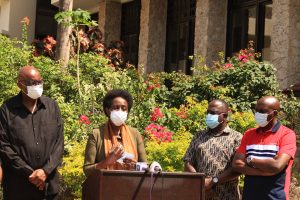
Dr. Hope Kivengere, APRM Panel Member in charge for Kenya addresses the press at a Mombasa hotel on Kenya’s targetted review. She is joined by APRM Continental Secretariat’s CEO Prof. Eddy Maloka (far left) and NAKS CEO Amb. Dr. Samori Okwiya (second from right) and NAKS Director of APRM & Governance Mr. Peter Kimemia.
Kenya will be reviewed on the Big 4 Agenda (affordable housing, manufacturing, universal health care, and food security).
The implementation of the Big 4 Agenda aims at directing investments to the projects and policies that will accelerate economic growth and transform lives by creating jobs, enabling Kenyans to meet their basic needs, improve health standards, improve living conditions, lower cost of living, and reduce poverty and inequality under the agriculture, manufacturing, health and housing sectors.
H.E. President Uhuru Kenyatta, during the launch of Kenya’s 2nd Country Review Report (CRR) at State House, Nairobi in March 2019, expressed his desire to undertake a targeted review on the Big 4 Agenda and cross-cutting issues identified in the CRR report. This process will culminate into the President being peer-reviewed in February 2022 during the AU Summit before his term in office ends.
Namibia, Djibouti, Zambia, and Sierra Leone have had their countries undergo a targeted review. Other states expected to have the targeted review are Uganda, Ghana, and Senegal.
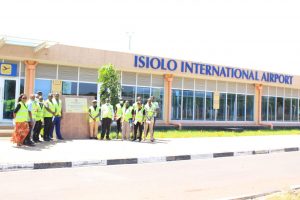
]]>Mr. Jeremiah Oguta, Building Technician Engineer with Kenya Airports Authority (KAA) based in Isiolo International Airport, confirmed this when he met with a team from NEPAD/APRM Kenya Secretariat led by the Secretariat’s CEO Amb. Dr. Samori Okwiya at the airfield’s offices today.
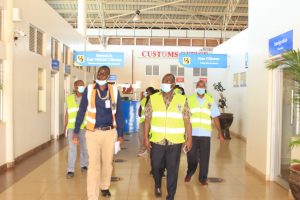
Additionally, Mr. Oguta affirmed that the expansion of the runway will grow the potential of the airport to accommodate bigger capacity aircraft and handle more cargo.
In his remarks, Amb. Dr. Samori Okwiya opined that the expansion of the runway will open the north-eastern circuit and enhance trade within the frontier region.
Mr. Jeremiah Oguta (left) leading the Secretariat’s team led by CEO Amb. Dr. Samori Okwiya (right) in an inspection tour of Isiolo International Airport.
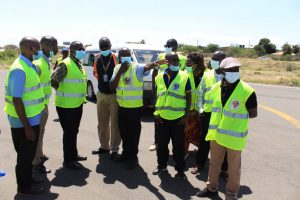
The Secretariat is on a monitoring and evaluation exercise of the LAPSSET Corridor programme in northern Kenya. In the next few days, the team will monitor and evaluate the Isiolo- Moyale highway and the One-Stop-Boarder Post in Moyale before concluding the exercise.
The LAPSSET Corridor Project will strengthen Kenya’s position as an access and a transport and logistics hub to East and Central Africa. This will facilitate Africa’s Continental Free Trade Agreement and promote regional economic integration.
This was said by President Uhuru Kenyatta during the 38th session of the NEPAD Heads of State and Government Orientation Committee (HSGOC) meeting which was held on 25th May 2021 at State House Nairobi, virtually.
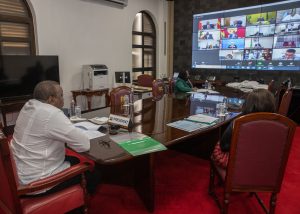
“NEPAD is an important tool that can help mobilize resources for the continent to enable it to achieve tremendous growth in all sectors,” the president said.
Additionally, President Kenyatta affirmed the role of NEPAD in promoting and ensuring successful implementation of the Presidential Infrastructure Champion Initiatives (PICI) among them the Lamu Port South Sudan Ethiopian Corridor (LAPSSET) programme.
Photo courtesy of State House- Facebook Page
“LAPSSET Corridor is intended to provide seamless connectivity across the footprint countries and enhance trade facilitation and logistics within the region. The implementation of the corridor is on course and has opened up the northern part of Kenya and the southern parts of Ethiopia and South Sudan”
President Kenyatta also spoke about the African Continental Free Trade Area (ACFTA) initiative stating that its success will enhance freedom of flow of goods and services among African countries which will progressively help Africans achieve sustainable development and complete economic unity.
The head of state urged African countries to work closely in handling future crises and pandemics, adding that such mutual cooperation will enhance the continent’s ability to deal with unforeseen predicaments. He also encouraged Africa Heads of State and Government to prioritize the continent’s infrastructure projects which will in turn solve the continent’s social-economic challenges through accelerated trade and sustained economic growth.
In attendance were Cabinet Secretary for The National Treasury and Planning Amb. Ukur Yattani, NEPAD/APRM Kenya National Governing Council Chairperson Prof. Michael Chege and the Secretariat’s CEO Amb. Dr. Samori Okwiya.
]]>Governor Amason Kingi has voluntarily submitted to the review sighting that it will help in ensuring that counties can learn and share best practices development and good governance.
Additionally, he noted that through the peer review process the gains made by devolution will be adequately captured objectively and as a result, Kenya’s growth and development will be noticed at an international level.
He confirmed this when he met a team from the NEPAD/APRM Kenya Secretariat which was led by Chief Executive Officer Amb. Dr. Samori Okwiya in his offices in Kilifi town today. Kilifi County is among the pilot counties selected for the peer review which is a governance program by the Secretariat.
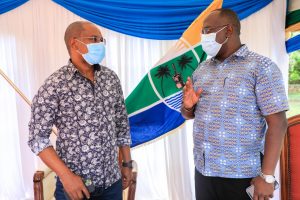
In his remarks, the CEO sighted that Governor Amason Kingi (Kilifi) was present at the Governor’s meeting held in 2017 to adopt the peer review mechanism in counties, and he is well aware of the benefits of the review.
Gov. Amason Kingi (left) have a tete-a-tete with CEO Amb. Dr. Samori Okwiya
The Secretariat’s Director of APRM and Governance Mr. Peter Kimemia gave a brief history of how Kenya acceded to the Africa Peer Review Mechanism process in 2003 where the first review report was done in 2006. The report commended Kenya for steady economic growth and high levels of literacy. However, it highlighted corruption and poor diversity management which sadly led to the Post Election Violence in 2007/2008 as the greatest challenges that the country needs to work on.
In 2017, Kenya was reviewed for the second time making her the first country in Africa to be reviewed twice. The 2017 review reports highlight the gains made by the State including the promulgation of the new constitution in 2010, the introduction of devolved system of government to enhance more representation of the people, creation of Huduma Centers which offer all government services to the population at a single spot and M-PESA which has sparked economic growth through easy mobile money transfer.
The CEO was also accompanied by Mr. Erick Kiilu, Ag. Director NEPAD Programmes, Mr. David Yalla, Deputy Director CPRM, and Mr. Frankline Kaburu the Communications Manager.
]]>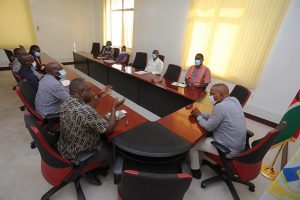 The Secretariat met the County Government of Mombasa yesterday to discuss the rollout of the County Peer Review Mechanism in the county.
Led by the C.E.O Amb. Dr. Samori Okwiya, the Secretariat met Dr. William Kingi, the Deputy Governor of the County Government of Mombasa to discuss the modalities of the peer review mechanism.
Mombasa county is among the pilot counties selected for the peer review which aims at achieving good governance in the counties. It borrows its methodology from the Africa Peer Review Mechanism (APRM) which is the continental self-assessment program of the Africa Union (AU) for African Heads of State and Governments.
Dr. Kingi affirmed the county’s commitment to good governance practice and is looking forward to being peer-reviewed.
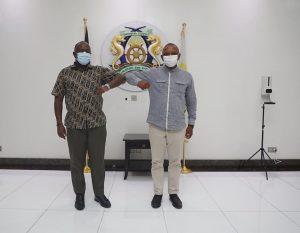
CEO Amb. Dr. Samori Okwiya (left) posses for a photo with H.E. Dr. William Kingi, the Deputy Governor of County Government of Mombasa
]]>Hon. Wafukho was received by the Chairperson of NEPAD/APRM Kenya Secretariat National Governing Council Prof. Michael Chege together with the Secretariat’s CEO Amb. Dr. Samori Okwiya.
CAS Wafukho was taken through the Secretariat’s organizational structure, the Africa Peer Review Mechanism (APRM) and, New Partnerships for Africa’s Development (NEPAD) Programmes that the Secretariat is involved in. Key among them being the targeted review of the Big Four Agenda, cascading of the APRM to the counties through the County Peer Review Mechanism (CPRM), cross-border infrastructure projects; the LAPSSET Corridor programme.
In his remarks, CAS Wafukho congratulated the Secretariat for the strides it has made in achieving its mandate.
“It’s highly notable that this Secretariat is tapping into indigenous leadership, knowledge, and resources in the execution of its mandate, whose results are noteworthy,” he said.
“I am gladdened by the NEPAD and APRM initiatives which seek to have African solutions to African challenges,” he added.
He affirmed his unconditional support to the Secretariat’s programs.
Also present during the meeting are Mr. James Maina, a member of the Secretariat’s National Governing Council and Secretariat’s staff.
]]>